Welcome to Your Child's Brain: How the Mind Grows From Conception to College by Sandra Aamodt & Sam Wang
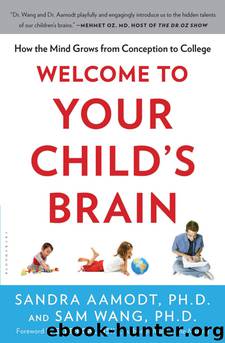
Author:Sandra Aamodt & Sam Wang [Sandra Aamodt & Sam Wang]
Language: eng
Format: epub
Tags: Pediatrics, Science, Medical, General, Child Development, Family & Relationships
ISBN: 9781596916494
Google: 3AHIfM7kviQC
Amazon: 1596916494
Barnesnoble: 1596916494
Publisher: Bloomsbury USA
Published: 2011-09-13T04:00:00+00:00
* * *
DID YOU KNOW? SELF-CONTROL PROMOTES EMPATHY
Babies often cry when they hear another baby crying, in the contagious form of empathy (see chapter 19). True empathy, the ability to appreciate other people’s feelings, develops by age five. Children show great gains in self-control during that same period, and individual children who have better self-control also show more empathy and a more developed conscience. Similarly, children who are better at inhibiting an automatic behavioral response (for example, by saying “day” when shown a picture of the moon, instead of “night”) tend to have a more sophisticated ability to imagine what other people are thinking and feeling, even when age, intelligence, and working memory are taken into account.
What’s the connection? To develop empathy, children need to have a certain ability to entertain alternatives and hypothetical possibilities, which is part of self-control. The prefrontal and anterior cingulate regions of the cortex are involved in both self-control and empathy, so cortical development may limit children’s ability to understand other people’s feelings and their ability to control themselves. As part of the brain’s attention-regulation system, the anterior cingulate is active when children concentrate on their own behavior or on other people’s feelings. Such concentration may be a necessary first step in the development of both these important functions. The prefrontal cortex is important for behavioral inhibition, and it is active during theory-of-mind tasks, which require people to concentrate on what someone else could know.
Download
This site does not store any files on its server. We only index and link to content provided by other sites. Please contact the content providers to delete copyright contents if any and email us, we'll remove relevant links or contents immediately.
| Administration & Medicine Economics | Allied Health Professions |
| Basic Sciences | Dentistry |
| History | Medical Informatics |
| Medicine | Nursing |
| Pharmacology | Psychology |
| Research | Veterinary Medicine |
The Art of Thinking Clearly by Rolf Dobelli(10495)
The 5 Love Languages: The Secret to Love That Lasts by Gary Chapman(9820)
Mindhunter: Inside the FBI's Elite Serial Crime Unit by John E. Douglas & Mark Olshaker(9347)
Becoming Supernatural by Dr. Joe Dispenza(8225)
Nudge - Improving Decisions about Health, Wealth, and Happiness by Thaler Sunstein(7712)
The Road Less Traveled by M. Scott Peck(7606)
Mastermind: How to Think Like Sherlock Holmes by Maria Konnikova(7353)
Enlightenment Now: The Case for Reason, Science, Humanism, and Progress by Steven Pinker(7316)
Win Bigly by Scott Adams(7204)
The Way of Zen by Alan W. Watts(6621)
Factfulness: Ten Reasons We're Wrong About the World – and Why Things Are Better Than You Think by Hans Rosling(4747)
The State of Affairs by Esther Perel(4725)
Gerald's Game by Stephen King(4659)
Man's Search for Meaning by Viktor Frankl(4611)
The Confidence Code by Katty Kay(4268)
Thinking in Bets by Annie Duke(4233)
The Healing Self by Deepak Chopra(3588)
Hidden Persuasion: 33 psychological influence techniques in advertising by Marc Andrews & Matthijs van Leeuwen & Rick van Baaren(3570)
The Worm at the Core by Sheldon Solomon(3492)
